
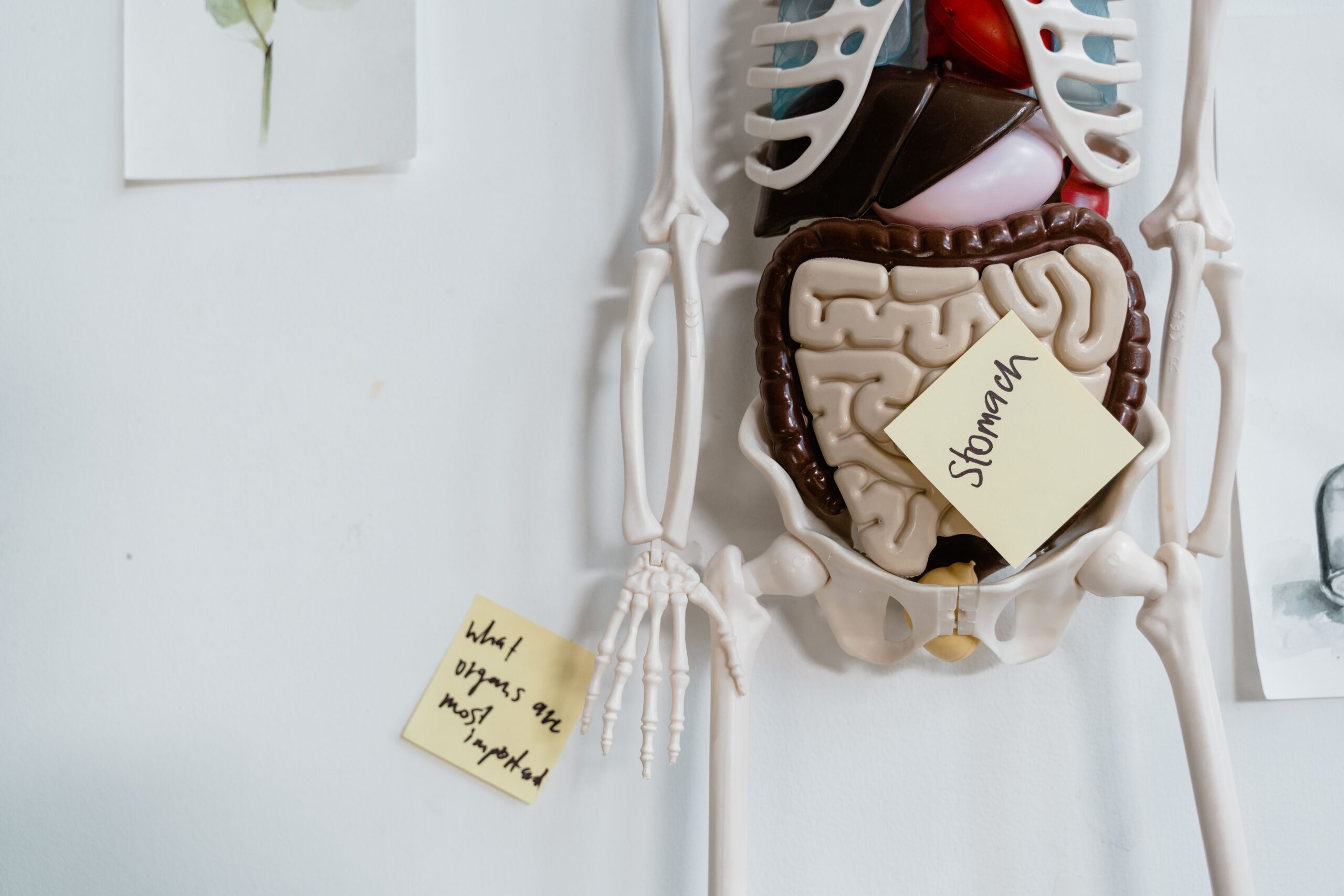
Most gut advice starts in the wrong place.
It starts with a list. Foods to cut, a supplement to add, a probiotic strain someone read about. And for a proportion of people that works, which is exactly why the advice keeps circulating.
For everyone else it produces a very particular kind of stuckness: a shrinking diet, a cupboard full of half-used bottles, and a growing suspicion that their gut is broken in some way nobody has managed to name.
This is the full version of a five-part series I ran called The Gut Health Blueprint. It follows the digestive tract from top to bottom, because that’s the order things actually happen in, and because a problem at one stage creates symptoms further down that get blamed on the wrong thing.
Contents
- Why the standard advice keeps failing
- The cascade, in one page
- Stage one: the mouth and the brain
- Stage two: the stomach
- Stage three: the small intestine
- Stage four: the large intestine
- Stage five: the nervous system underneath all of it
- Working out which stage is yours
- Key takeaways
- Practical checklist
- Frequently asked questions
Why the standard advice keeps failing
Here’s the thing that took me a while to appreciate properly in clinic.
Almost every piece of popular gut advice is aimed at one variable: what goes in. Cut this, add that, try a fortnight without gluten. But digestion is a sequence, and what goes in only matters in the context of what happens to it at each stage.
Two people can eat the same meal and end up with completely different outcomes. Not because one of them has a moral failing about food, but because one of them ate it in four minutes standing up, or has low stomach acid, or has a motility pattern that leaves residue sitting where it shouldn’t.
Same input. Different machinery.
So the useful question isn’t “which food is doing this to me.” It’s “where in the sequence is this going wrong.”
That question is answerable. It just requires working through the stages rather than starting at the supermarket.
The cascade, in one page
Five stages. Each one hands off to the next, and each one can create symptoms that look like they belong somewhere else.
- The mouth and the brain. Mechanical breakdown, the first enzymes, and the signals that tell the rest of the tract that food is coming.
- The stomach. Acid, pepsin, sterilisation, and the controlled release of partly digested food into the small intestine.
- The small intestine. Where most digestion and nearly all absorption happens. Also where the cleaning wave runs between meals.
- The large intestine. Water recovery, fermentation, and the formation of stool.
- The nervous system. Running underneath all four, setting how well the machinery works and how loudly you feel it.
The classic mistake is treating a stage four symptom as a stage four problem. Bloating shows up in the lower abdomen, so people target the colon: more fibre, a probiotic, fewer beans. Often the actual failure was two stages up.
Stage one: the mouth and the brain
Digestion starts before the first bite
Seeing food, smelling it, or thinking about it triggers saliva and gastric secretion in advance. This is the cephalic phase, and it’s the run-up to the meal rather than part of the meal itself.
Skip the run-up and the stomach receives food with less preparation than it would otherwise have had.
Chewing is doing more than you think
Two jobs. It breaks food into pieces small enough for enzymes to work on, because enzymes act on surface area, and a swallowed lump has very little of it. And salivary amylase makes an early start on starch.
Eating fast is one of the more consistent things I see in people with bloating. The mechanism people usually cite for it is fermentation in the colon, but the better-supported explanations sit higher up: swallowed air, and a stomach being distended quickly by a large volume arriving in a short space of time.
That distinction matters, because it changes what you’d do about it. Air and volume are a pacing problem. Fermentation is a substrate problem. Different fix.
What to actually do
- Sit down for meals where you can. Not always possible. Most days is enough.
- Chew until the texture changes rather than counting to a number.
- Put the fork down between mouthfuls if you’re a fast eater. It’s the only technique I’ve found that reliably works.
Stage two: the stomach
What stomach acid is for
Three jobs, and only one of them is digestion.
- Activating pepsin. Pepsinogen only converts to its active form in an acidic environment. No acid, no protein digestion at this stage.
- Sterilising. Stomach acid kills a good proportion of what arrives with food.
- Signalling. The pH of what leaves the stomach helps trigger the release of pancreatic enzymes and bile downstream.
That third one is the one people miss. The stomach isn’t just processing food, it’s telling the next stage what to do.
The confusing bit about reflux
Reflux symptoms and low stomach acid can look identical from the outside. Burning, fullness after meals, that sense of food sitting there too long.
The internet has decided this means most reflux is caused by low acid. I’d be more careful than that. What’s fair to say is that the symptom picture doesn’t reliably tell you which way the acid is going, and that a proportion of people who are certain they have too much acid have never had it measured.
Acid and bacterial overgrowth
Reduced acid allows more bacteria to survive into the small intestine, which can then contribute towards overgrowths or imbalances .
Stage three: the small intestine
Where the work actually happens
Most digestion and almost all nutrient absorption happen here, across a surface area that is enormous relative to the length of the organ. Pancreatic enzymes handle the bulk of the chemical breakdown. Bile emulsifies fat. Brush border enzymes on the intestinal lining finish the job on the final sugars, lactase among them.
That last detail explains something people find confusing. Brush border enzyme activity depends on the condition of the lining, so damage or inflammation there can reduce lactase activity without anyone having been born lactose intolerant. Secondary intolerance is common, and it can improve.
The cleaning wave
Between meals, when the small intestine is empty, a pattern of contractions sweeps through it. This is the migrating motor complex, and it’s essentially housekeeping: moving residue and bacteria downstream towards the colon.
It runs when you’re not eating. Eat again and it stops.
Which is where the stop grazing argument comes from. If you eat every ninety minutes from waking to bed, the cleaning wave gets fewer opportunities to complete a full cycle.
Small intestinal bacterial overgrowth
SIBO gets discussed as a bacteria problem. In practice it’s better understood as a clearance problem.
Bacteria in the small intestine aren’t abnormal in themselves. The problem is when too many are there, fermenting food before you’ve absorbed it, which produces gas high in the tract, where there’s much less room for it. That’s why SIBO bloating so often starts within an hour of eating rather than building through the day.
The things that predispose to it are mostly things that impair clearance: slow motility, previous gut infection, structural issues, adhesions from abdominal surgery.
The pattern to watch for
An expanding list of food reactions is one of the more useful signals I see. Not one stubborn trigger. A list that keeps growing, where things that were fine six months ago now aren’t.
That pattern points at the terrain rather than the foods.
Stage four: the large intestine
Three jobs
- Water and electrolyte recovery. Material arrives fairly liquid. How long it sits here determines how firm it ends up. This is why transit time and stool consistency are the same conversation.
- Fermentation. Bacteria break down what you couldn’t digest upstream. Fibre, resistant starch, some sugar alcohols. Gas is a normal by-product, not a fault.
- Storage and clearance.
Fibre is a category, not an ingredient
“Eat more fibre” is the most repeated gut advice there is and one of the vaguest.
Three properties determine how a given fibre behaves once it arrives:
- Whether it dissolves in water
- Whether it forms a gel
- How quickly bacteria ferment it
Those combine differently in different fibres.
Psyllium dissolves, gels, and ferments slowly. That combination is why it holds up best in IBS: it changes stool consistency in both directions without producing a large gas load.
Inulin and FOS dissolve and ferment quickly. Genuinely useful for feeding bacteria. Also a poor first choice if your main symptom is already gas.
Wheat bran does neither. It bulks. NICE guidance specifically advises against bran in IBS.
So someone can follow “eat more fibre” perfectly, pick up the wrong one, and end up worse. That isn’t them doing it wrong.
Where probiotics fit
Modestly, and with less certainty than the marketing suggests.
Effects are strain-specific rather than general, which means the evidence for one product tells you very little about another. Some strains have reasonable data in IBS. Most products on shelves aren’t those strains, and dose and viability at the point of consumption are variable.
Worth trying, in the right order, with a defined period to judge it over. Not the foundation of a strategy.
Stage five: the nervous system underneath all of it
This is the stage that gets left out, and in clinic it’s often the one that explains why the previous four weren’t enough on their own.
Two dials
Your nervous system state turns two dials at once.
The first controls the machinery. In a stress-dominant state, blood flow moves away from the gut wall, secretion falls across the board, and motility changes rather than simply slowing. Acute stress tends to slow gastric emptying while speeding transit through the colon, which is why nerves can produce a heavy full stomach and an urgent bowel at the same time. Two symptoms that feel unrelated, one mechanism underneath.
The second controls the volume. In research settings, a small balloon can be inflated in the rectum or colon to find the point at which sensation becomes uncomfortable. A substantial proportion of people with IBS report discomfort at volumes that others barely register. Not everyone. But enough that visceral hypersensitivity is considered one of the central features of the condition. Brain imaging has added to the picture, showing differences in how gut signals get processed centrally.
Same gas. Different pain.
Why this changes the plan
If sensitivity is turned up, cutting foods lowers the amount of gas produced but does nothing to the dial itself. The sensitivity keeps outrunning the restriction, and the trigger list grows.
Twelve safe foods, still bloated. It’s one of the most demoralising positions to be stuck in, because from the inside it looks like evidence that your gut is uniquely broken.
It isn’t uniquely broken. It’s louder.
And to be clear, because this gets twisted constantly: the gas is real and the pain is real. What’s altered is the gain on the signal, and gain is a physical property of a nervous system. Nobody is imagining anything.
The serotonin myth
You’ve probably seen the line that 90% of your serotonin is made in your gut, usually followed by something about mood.
The first half is roughly right. The second half doesn’t follow. Gut-derived serotonin doesn’t cross into the brain, the two pools stay separate, and what it does locally is regulate motility and signalling. The gut does influence the brain, through the vagus nerve, microbial metabolites, and immune and hormonal routes. Just not by that one.
The therapies worth knowing about
Gut-directed hypnotherapy and CBT have a real evidence base in IBS, and NICE guidance suggests considering psychological interventions where symptoms haven’t responded to other approaches after twelve months.
That isn’t what you get offered when tests come back clear and nobody knows what else to say. It’s an intervention aimed directly at the second dial.
Working out which stage is yours
No test tells you this outright. But the timing and character of symptoms narrow it down considerably.
Symptoms within 30 to 60 minutes of eating, high in the abdomen, often with fullness. Look upstream. Stomach and small intestine.
Bloating that builds through the day and peaks in the evening. More consistent with colonic fermentation and transit.
An expanding list of food reactions. Points at terrain rather than any individual food.
Symptoms that track your week better than your plate. Nervous system involvement, likely combined with something mechanical underneath.
Fibre made it worse. Usually the wrong fibre rather than too much of it.
Everything improves markedly on holiday, including when eating more. Very strong signal for stage five.
Most people are not a clean single stage. The point of narrowing it down isn’t to arrive at one answer, it’s to decide what to look at first, because the order you address things in makes a real difference to whether anything moves.
Key takeaways
- Digestion is a sequence, and a failure at one stage produces symptoms that look like they belong at another
- Chewing and eating pace affect bloating mainly through swallowed air and rapid gastric distension, not fermentation
- Stomach acid does three things, and the signalling role is the one most often overlooked
- SIBO is better understood as a clearance problem than a bacteria problem
- Fibre is a category, and the specific fibre matters more than the amount
- Visceral hypersensitivity is a central feature of IBS and explains why elimination diets stall
- Nervous system state controls both how well digestion runs and how strongly you feel it
- Normal test results rule out serious disease. They don’t mean there’s nothing to explain
Practical checklist
- Track symptoms against timing, not just food, for two weeks
- Note how rushed each meal was and how you slept the night before
- Sit down for meals where you reasonably can
- Put your fork down between mouthfuls if you eat fast
- Leave real gaps between meals rather than grazing continuously
- Stop adding new restrictions during a flare
- Give any probiotic a defined trial period and a defined outcome to judge it on
- Prioritise sleep before adding supplements
- Take any red flag symptom to your GP rather than working around it
When to see your GP
Some symptoms need medical assessment rather than a nutritional approach. Please don’t work around these:
- Blood in the stool, or black stools
- Unintentional weight loss
- Symptoms that wake you from sleep
- New bowel habit changes over the age of 50
- A family history of bowel cancer, coeliac disease or inflammatory bowel disease
- Iron deficiency or anaemia
- Difficulty swallowing, or persistent vomiting
Frequently asked questions
Do I need a stool test or a SIBO breath test to work this out?
Not necessarily, and not as a first step. Testing is most useful when it will actually change what you do next. A detailed history covering symptom timing, bowel pattern, medical history and previous responses to interventions often narrows things down more than a test does, and it costs nothing.
If my colonoscopy and bloods were normal, does that mean nothing is wrong?
No. Those tests are looking for structural disease and inflammation, and they’re very good at that. IBS and functional gut disorders are diagnosed on symptom criteria after that sort of investigation comes back clear, which is a positive diagnosis rather than a lack of one. Normal results are reassuring and worth having. They just aren’t an explanation.
Should I be taking a probiotic?
Possibly, but not as the first move and not indefinitely without reviewing it. Effects are strain-specific, so the evidence behind one product tells you almost nothing about another. If you try one, give it four to eight weeks, decide in advance which symptom you’re judging it on, and stop if nothing has changed.
Why did cutting out gluten and dairy work for a while and then stop?
It’s one of the most common patterns I see. Usually it means the restriction reduced the load on a system that was already struggling, which brought short-term relief, without changing whatever made the system sensitive in the first place. Sensitivity then continues to rise and starts outrunning the diet. The answer at that point is very rarely another food group.
How long does it take to see a change?
It depends entirely on which stage is driving it. Adjusting eating pace and meal spacing can produce noticeable change within a fortnight. Motility issues, post-infectious changes, and visceral hypersensitivity work on a longer timeline, often two to three months of consistent work before the picture is clear. Anyone promising a fixed number without knowing your history is guessing.
Want help working out which stage is yours?
Most people arrive having already tried the food-based answers. The useful work is usually figuring out where in the sequence things are actually going wrong, and in what order to address it.
That’s what the discovery call is for. 30 minutes, free, no pressure, and you’ll leave with a clearer sense of where to look first.
Leave a Reply